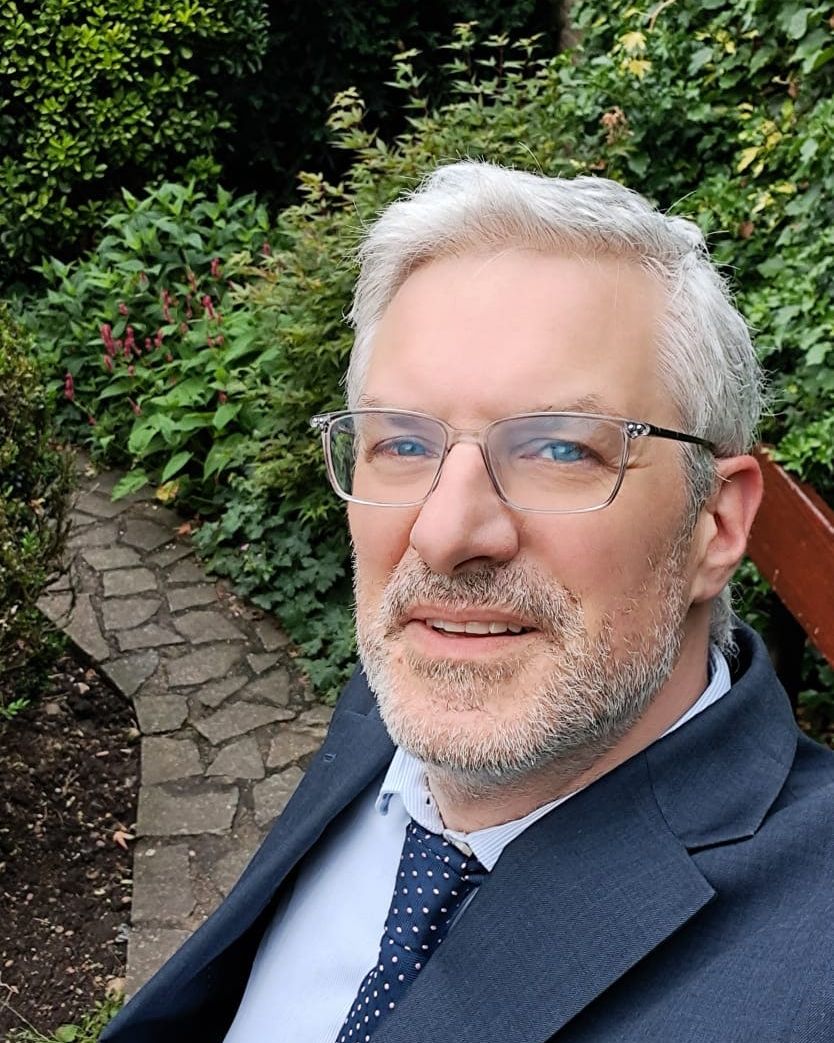
The family business, and its tech support.
My mum's family had a manufacturing business. They made heating equipment for laboratories, and cookers for Army tanks. Yes, really: somebody has to make sure there's a brew on the go inside a Challenger. When my grandfather passed away, my dad took over running it. At its peak it employed 400 people.
And in the 1990s, my dad was also its tech support.
Not officially, of course. But when a PC froze or the server needed coaxing back to life, it was him who ended up dealing with it. Countless hours of a man who should have been running a 400-person family business, spent instead on computers. It wasn't a good use of his time, and he knew it.
So when he had problems, I fixed them. It turned out I was good at it, and I liked it. There's a particular satisfaction in watching someone's shoulders drop when the thing that's been ruining their afternoon just works again. Looking back, that's where Techsperience really began: trying to give my dad his time back.
A year at IBM, at exactly the wrong (right) time.
Before university I spent a year at IBM, in 1994, right in the middle of the Lou Gerstner turnaround. The company was laying people off on a scale nobody had really seen before. Not the pre-university students, mind you; we weren't worth the paperwork. So I had a front-row seat to a huge corporate culture being taken apart and rebuilt around me, at eighteen.
My job was testing Person to Person, a multi-person video-calling platform. That's video calls, in 1994. It had to work over almost every network of the day: Token Ring, Ethernet, Novell NetWare, Banyan VINES, ISDN and dial-up. I was handed a laptop worth over £20,000, with its own graphics, sound card and video camera, to test it on. Not to keep, sadly. We were using Gopher to find things online, and Netscape Navigator was the exciting new arrival.
It taught me two things I've never forgotten. Technology changes everything, quickly. And how a company treats people when things change tells you everything about it.
Then university.
I went on to study Computer Systems Engineering. By the time I left, I could, in theory, design a chip from sand and then program it. In practice I was missing the billion pounds you'd need for a silicon fab, so I did the next best thing. I went back to helping people whose computers were getting in the way of their real work.
The job I didn't apply for.
After university I applied to a small management consultancy for a job as assistant IT manager. They offered me the role of junior consultant instead. They thought I'd be after the IT manager's job within a year, and decided that sort of ambition belonged in front of clients. Those were big blue-chip names, including UDV (now part of Diageo) and Volkswagen, and the work was through-the-line marketing.
They weren't wrong about the ambition. Within six months I was doing the IT manager's job as well as the consulting, on a trainee's salary. At some point you do the maths. I left and started my own IT consultancy: Ben's IT Solutions Ltd. BITS, for short. I was quite pleased with that.
The first two clients.
My first client was a car rental business with three offices, and in 1999 they had a Y2K problem: their booking software wasn't going to survive the millennium. They needed a replacement, so I wrote one. Freeway 3 ran on Windows, looked the part, and had a Gantt chart showing where every car needed to be and when. That was pretty unusual in 1999. They ran the company on it until the owner sold up in 2012. Thirteen years on software I wrote at twenty-three. I'm still proud of that one.
Later that year a friend of mine was working at a hedge fund, the UK's first long/short fund as it turned out. He knew I was running an IT business and wanted to move into IT support. The fund wanted someone good to look after their IT one day a month, so they lined up a beauty parade of the best firms around and gave every one of us the same broken system to fix.
I fixed it in 17 minutes. The next closest took six hours. Two of the others said it couldn't be done.
I got the work.
Four names, one company.
The company started life as 256 Ltd, bought off the shelf. (An engineer's favourite number: it's how many values fit in a byte.) It became Ben's IT Solutions, or BITS, which I still think was rather good. But it was about me rather than where the company was going. So we became Fulcrum IT Services. A fulcrum is the turning point, the small thing everything else pivots on, and that's what good IT should be for a business.
Then a US firm with a very similar name started trading in the UK, and it felt like the right moment for a fresh start anyway. We became Techsperience, and this time I trademarked it.
The names changed as the company grew up. The reason for it never did.
Why I still do it.
I have two children: a son who's fourteen and a daughter who's twelve. They have a clear view of the family hierarchy. Daddy's only the boss at work. At home, Mummy's the boss.

They're right, of course. But it's made me think about what kind of boss I am at work, and what they'll make of it when they're old enough to look properly.
I want them to see a business that's run with integrity, and I try to make that something you can see in what we actually do. We turn work down when a firm won't do the right thing, which is usually about security. That's never an easy conversation, but if we can't look after a firm properly, we'd rather not pretend to.
We also tell people when they don't need something. Over the years that's included more than one request for a very fast gaming PC. (They're lovely machines. They're not for document management.) Instead, we'll use our own Microsoft cloud time to test-run the system first, so a firm can see exactly what it needs before spending a penny.
I want my kids to look at what I've built and be proud of how it was done, not just that it was done. And I want the firms we look after to be measurably better off for knowing us.
Where we're going.
We're building tech support for the future of law, whatever that turns out to hold.
Right now, that means AI. Not AI for the sake of a press release, but AI that actually supports the people using it: secure, and working alongside the processes a firm already has. Where a firm's processes aren't ready for it yet, we help them get there, at whatever pace and in whatever way makes sense for them.
It's also why, alongside Techsperience, we build Clearmatter, matter-management software for small firms, and publish Operate Legal, a free operations library for the people running them. Same world, same reason.
When I think about it, it's the same job I started doing for my dad thirty years ago. Something new arrives, it's supposed to make life easier, and somebody has to make sure it actually does. I still love being that somebody.
If that sounds like the kind of firm you'd want looking after yours, I'd genuinely love to hear from you. Get in touch →
Ben